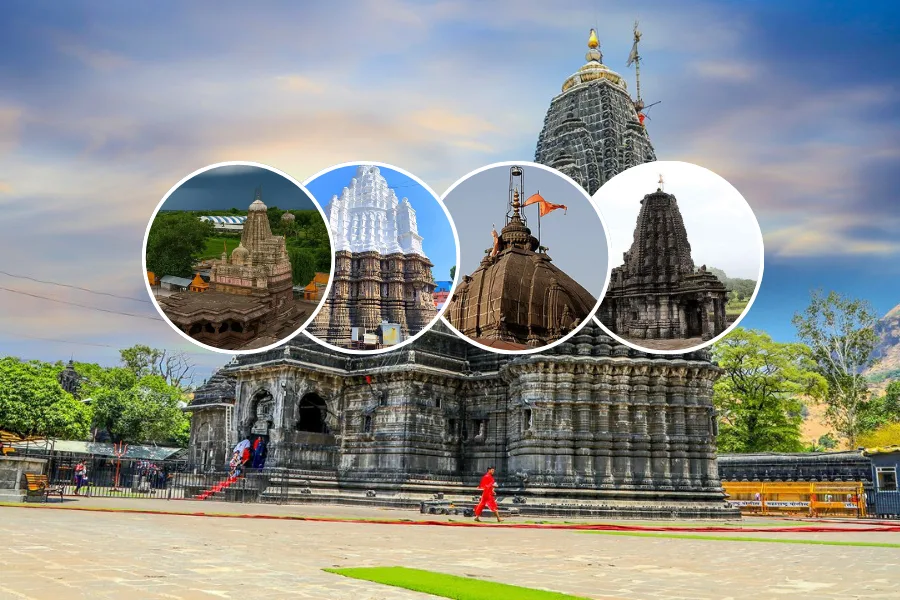
A home to 5 jyotirlingas out of twelve, Situated in the lap of Maharashtra. The five jyotirlingas are Trimbhakeshwar, Bhimashankar, Grishneshwar, Aundhanagnath, and Parli Vaijnath. The temple town is known as the oldest living city in the world. The Trimbakeshwar temple near Nashik is a jyotirlinga shrine associated with the origin of the Godavari river.
The Maharashtra jyotirlinga tour is a sacred journey undertaken by devotees seeking spiritual fulfilment. These jyotirlingas are considered self-manifested forms of Shiva. It is believed to be a powerful centre of divine energy.
Route Options And Religious Significance
The typical route starts from Mumbai, followed by Pune and ends in Aurangabad. There could be three itinerary options for this religious tour. The first one starts from Aurangabad: Grishneshwar - Trimbakeshwar - Bhimashankar and ends at Mumbai/Pune.
The other itinerary could start from Mumbai/Pune and end in Aurangabad. Bhimashankar - Trimbakeshwar - Grishneshwar - drop in Aurangabad. The last route one can start with is from Shirdi. Visit Trimbakeshwar. Travel to Bhimashankar, Grishneshwar, Aundha Nagnath, and Parli Vaijnath, and end at the start point or Mumbai/Pune.
These jyotirlingas are believed to be self-manifested by Shiva and are a representation of his infinite nature. Visiting these shrines is considered to be a journey towards inner peace and understanding the profound facets of Hinduism. These five jyotirlingas in Maharashtra are a must-visit for spiritual growth.
Trimbakeshwar Temple: Spiritual Essence
It is a significant Hindu shrine dedicated to lord Shiva. One of the oldest Shiva temples famous for its three-faced lingam, which represents Brahma, Vishnu, and Shiva. It is also renowned for being the source of the holy river Godavari. The river originates from the Brahmagiri Hills near Trimbakeshwar.
Trimbakeshwar Rituals And Architecture
The daily rituals at the temple involve Kakad aarti at 5:30 am. Followed by Abhishekam, bathing of the jyotirlinga, with water, honey, milk and other offerings. They also have a morning aarti for Brahma Dev at 7 am. Mid-day puja of Mahadev at 10:45 am. The evening puja of Vishnu will be at 7 am, and the day will conclude with Shejerati at 9 pm.
The temple showcases the hemadpanthi style of architecture. The temple has many intricate carvings, sculptures and decorations. The construction is based on black basalt stone. It is a prominent example of ancient Indian craftsmanship. The temple also consists of a sacred pond, Kushavarta kund, believed to be the origin of the Godavari river. A journey to these five jyotirlingas in Maharashtra gives one the peace that one seeks throughout their life.
Bhimashankar Temple: Shiva in the Sahyadris
A major pilgrimage site for the devotees of lord Shiva. A must visit of five jyotirlingas in Maharashtra. It houses one of the twelve jyotirlingas, a sacred representation of lord Shiva. It is also known for its wildlife century and diverse flora and fauna. The place offers much more than spiritual significance; it showcases the biodiversity. The temple is located on the edge of Sahyadri hills, offering a wonderful view of the wilderness.
Trekking To Bhimashankar And Temple rituals
The regular rituals at the temple are the same as those at Trimbakeshwar. But there are some rituals specific to Bhimashankar. These rituals involve Laghu Rudra Abhishek, which involves offering eleven ingredients to the lingam. The devotees also perform a ritual that involves offering water from the Chandra Bhadra river in pots to lingam. This ritual is known as Kanwar Yatra.
There are major 2 routes that will reach the temple. The first route is the Ganesh Ghat, which has scenic views and ease of use. On the other hand, the other route is quite challenging and steep. This route is called Shidi Ghat. Trekking to Bhimashankar is an experience one must try once in their lifetime.
If one is looking for adventure and trekking, then one must go to Shidi Ghat. Both the routes start from the same base, Khandas village. Trekking to Bhimashankar will be memorable if one chooses the Shidi Ghat route.
Grishneshwar Temple: The Last Jyotirlinga
It is one of the twelve sacred shrines of lord Shiva. The final and twelfth jyotirlingas are located in the Verul village. One of the unique features of this jyotirlinga is that devotees can touch the lingam and seek blessings. It is not common with other Shiva lingams. It is mentioned in many sacred texts, such as Shiva Purana. These historical contexts make the oldest Shiva temples worth the visit.
The proximity of the temple makes it a unique experience for devotees and tourists. It is an easy itinerary for tourists. Many people choose to visit the Ellora caves and the temple on the same day. The visit gives one a spiritual and historical experience.
Aundha Nagnath Temple: The Oldest Jyotirlinga
The temple has its roots dating back to the era of Mahabharata. Legends suggest that Yuthishthira built the temple during their exile. Its historical significance also lies with the Seuna dynasty, who reconstructed the temple in the 13th century. Reconstructed in the 13th century, the temple became one of the oldest Shiva temples.
Historical Importance And Unique Rituals
Holding importance as one of the twelve jyotirlingas, it dates back to the era of Mahabharata. Believed to be the eighth jyotirlinga. The temple showcases a distinctive type of Hindu temple architecture in Maharashtra. Its historical significance makes it one of the oldest Shiva temples to visit.
Considering the importance of each jyotirlinga, the eighth jyotirlinga involves certain unique rituals. They perform rituals like all-night vigils, bhajans, and Rudra Abhishek, which are practised especially on Shivratri.
Parli Vaijnath Temple: Shiva the Healer
The name itself suggests the lord of healing, Vaijnath. It highlights the association of the temple with healing and good health. Devotees believe that worshipping in Vaijnath temple brings good health and relief from illnesses. Considered to be a place where one can recover and regenerate.
Parli Vaijnath Temple is nestled in the heart of Maharashtra's Beed district. It is one of India's most sacred jyotirlingas, dedicated to lord Shiva. It is surrounded by lush green natural beauty. The unique natural surroundings make it spiritual, peaceful and a must-visit Jyotirlinga. This atmosphere makes Maharashtra jyotirlinga tour a must.
Jyotirlinga Travel, Stay And Darshan Timings
The darshan times for each jyotirlinga are different for each destination. If one wants to have the blessings of each, then one needs to follow the timing of each one as follows: Bhimashankar - 5 am to 9:30 pm daily. Trimbakeshwar - 6 am to 9 pm, Grishmeshwar - 5:30 am to 9:30 pm, Nageshwar - 5 am to 9 pm and Parli Vaijnath - 5 am to 9:30 pm.
While travelling to divine locations, one can choose to stay in budget-friendly hotels and Dharamshalas for a better experience of spirituality that includes:
Shri Maheshwari Bhakta Niwas
This Dharamshala is located 600 meters from the temple. They provide amenities like TV, hot water and canteen facilities and rooms are non AC. Check-in time is 2 pm, and check-out is 12 pm.
Twin Mountain Farm Resort
The hotel is located 6 km from the temple. They provide amenities like AC rooms, TV, shower, queen-size beds, WiFi and a parking area. A restaurant and swimming pool are a plus. The check-in time is 12 pm, and the check-out time is 11 am.
Best Time To Visit Jyotirlingas
The temples are accessible from October to March. It is considered the peak time for Maharashtra jyotirlinga tour as the atmosphere was cool during that time. Considering Maharashtra as a humid place, one must choose a duration of monsoon for pilgrimage.
Although less crowded during summer, the humidity might make the travel uncomfortable for the pilgrims. If you are a person who likes to travel in less crowded areas, then you can choose a destination like Maharashtra for a jyotirlinga tour. Monsoons are quite heavy there but give a very pleasant experience. It might hamper one's travel due to heavy rains and landslides, though.
Festivals And Celebrations
Festivals like Mahashivratri are celebrated with chanting mantras, and devotees observe fast and perform abhishek. Temples are adorned with lanterns, flowers and other decorative materials. People also devote themselves to lord Shiva by staying awake all night and chanting mantras.
Grand processions of idols of lord Shiva are organized and accompanied by dance and music.
Shravan is considered a pious month for Hindus, and devotees offer water, milk, honey, and bael leaves to Shivlinga. Mondays of this month are especially considered as auspicious. Devotees engage themselves in special prayers and rituals.
Travel Tips for a Hassle-Free Jyotirlinga Tour
Always consider booking in advance before you plan to go anywhere. One can reach these temples from Pune or Mumbai and take a cab for a smoother journey. If one is planning to take a guided tour, then one can consider Kesari Tours and Swastik Holidays offer packages. These are some famous Maharashtra jyotirlinga tours guides to consider for a safe and sound trip.
Book railways and accommodation in advance for a hassle-free tour. Check with the hotel's booking and cancellation policies to avoid any last-minute issues. Keeping the weather in mind, one must carry sunglasses, a hat, a light scarf and a reusable water bottle.
Exploring Nearby Attractions
Apart from being a spiritual place, Maharashtra is a place where people come to enjoy nature. There are many places near the jyotirlingas where devotees can enjoy spiritual and historical sites like Ananta and Ellora caves, Shirdi, and Panchvati.
Ellora Caves
Located in Aurangabad, Maharashtra. The caves are a UNESCO world heritage site. It is one of the largest rock-cut cave complexes in the world, with artwork dating from 600-1000 AD. This complex comprises Hindu, Buddhist and Jain caves.
Shirdi
A town in the state of Maharashtra, known as the former home of revered spiritual leader Sai Baba. It is a major pilgrimage site for devotees, including Hindu religion. Daily, a large number of devotees gather to honour his legacy. The Samadhi mandir has an ornate marble statue of Sai Baba.
These are some of the places one would like to visit on a Maharashtra spiritual tour.
Local Cuisine to Try During the Jyotirlinga Tour
A spiritual tour is incomplete without trying its local cuisines. Food is the main source of nourishment and survival and the best way to enjoy a tour. Maharashtra, considered one of the major places in India, has its taste buds lying in Puran Poli, Vada pav and Modak. This Maharashtrian cuisine guide will leave your taste buds in awe.
Puran Poli
It is a staple dish during festivals in Maharashtra. It is a symbol of joy and togetherness. It is a sweet filling of chana dal and jaggery combined with the use of ghee. This Maharashtrian cuisine guide dates back to the 17th century, when it was considered to be a source of providing energy to warriors.
Modak
Modak is believed to be Lord Ganesha's favourite dish. It is also seen as a symbol of wealth, knowledge and intelligence. The traditional steamed modak is made of rice flour, jaggery and coconut.
It is often served with ghee to Lord Ganesha on festivals and special occasions. The Maharashtra spiritual tour is incomplete without trying the traditional modak. While traditional modaks are still famous, there is a variety of them today. These are just a few dishes from the region to explore more tune into Maharashtrian cuisine guide.
Maharashtra Temple Shots Photography Tips For Capturing the Jyotirlingas
Seeking permission before one starts to click pictures is important. Respectful angles are necessary to capture the essence of the place. Be discreet and quiet, as there will be other devotees around seeking blessings and performing rituals. Avoid using flash, which might interrupt rituals. Do not click selfies with deities.
Including pictures of scenic beauty, architecture, and rituals can enhance your experience of clicking pictures and capturing memories. Understand the customs of the place and follow things like dressing modestly and removing shoes before entering the temple. These Maharashtra temple shots will amplify one's experience as a traveller.
Eco-Friendly Pilgrimage Practices
Utilize trains and buses while travelling in Maharashtra. Consider hiring a local driver if one is travelling for a short distance. Choose eco-conscious accommodation that prioritizes sustainable practices. All these small habits help the tourism to grow and enhance the Maharashtra temple shots.
Enjoy meals at local restaurants that use fresh seasonal ingredients and support the local economy. Carry a reusable water bottle to avoid any waste, and dispose of it properly to avoid any harm to the environment.
Promoting a three-way segregation enables proper recycling and composting of waste. These considerations make the Maharashtra spiritual tour a successful one.
FAQ: Planning a Maharashtra Jyotirlinga Tour
Travel
How to get there?
Reach the nearest major city by plane, train or bus, followed by local transportation.
Are there tour packages?
Yes, IRCTC tourism and other travel agencies have tour packages that include transportation, accommodation and sometimes even meals during the pilgrimage.
Rituals And Customs
What is the dress code?
The dress code isn't specifically strict, but modest dress should be a part of the dress code. Try wearing a saree or a salwar suit.
What are the timings for darshan?
Most jyotirlinga temple timings are from 5 am to 9:30 pm.

 3 Nights / 4 Days
 3 Nights / 4 Days
 3 Nights / 4 Days
 4 Nights / 5 Days